Many foreign companies run their Korean business through a 100% Korean subsidiary. A common question is: "Can our Korean subsidiary be treated as the permanent establishment (PE) of the foreign parent?" The short answer: owning a subsidiary alone does not create a PE, but the way the subsidiary and the parent actually work can. Below we explain this in four steps, using Korean law, Korean tax rulings and Korean court cases only.
1. What is a PE?
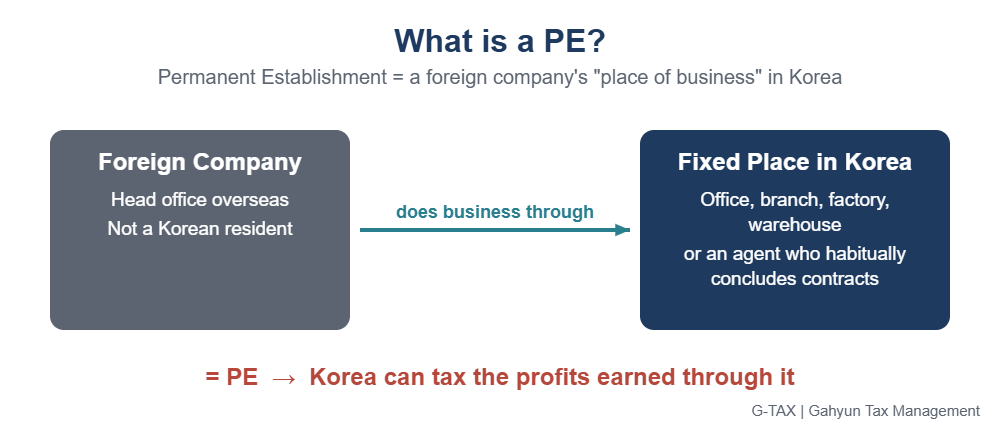
A PE (permanent establishment) is a foreign company's "place of business" in Korea. Korean law calls it a domestic place of business (국내사업장).
- Fixed place – If a foreign company has a fixed place in Korea where it carries on all or part of its business (office, branch, factory, warehouse, etc.), it has a PE (Corporate Tax Act Art. 94(1)).
- Service place – A place where the foreign company provides services through its employees for more than 6 months within 12 months is also a PE (Art. 94(2)).
- Agent – Even without a fixed place, if a person in Korea habitually exercises authority to conclude contracts for the foreign company, the foreign company is treated as having a PE there (Art. 94(3) and Enforcement Decree Art. 133).
- Exclusion – Places used only for preparatory or auxiliary work, such as simply purchasing or storing goods, are not a PE (Art. 94(4)).
2. What does it mean to "Having a PE"?
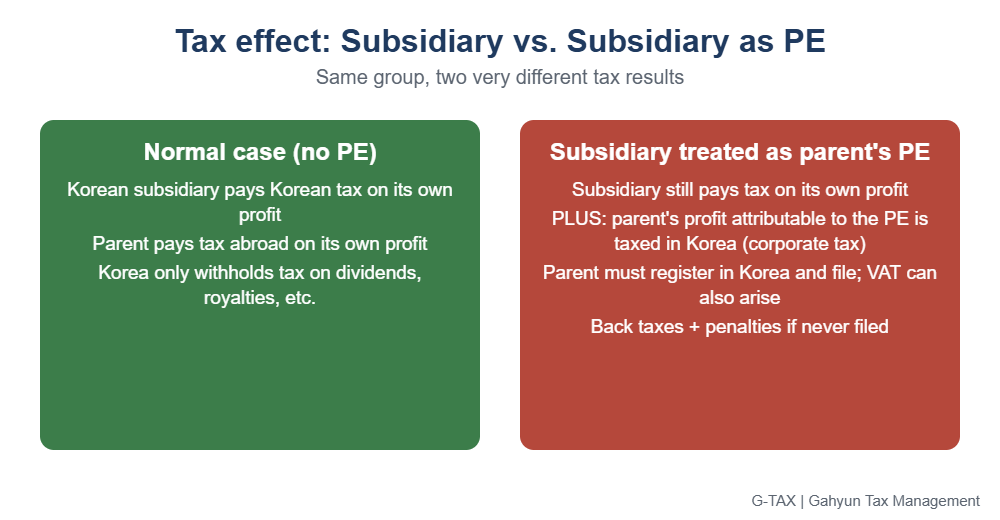
A Korean subsidiary is a separate Korean company. It always pays Korean corporate tax on its own profit. Normally, the foreign parent is taxed in Korea only through withholding tax on dividends, royalties, interest, etc.
If the subsidiary (or its office) is treated as the parent's PE, things change:
- The parent's own business profit that is attributable to the PE becomes taxable in Korea (corporate tax), in addition to the subsidiary's tax.
- The parent must register a place of business in Korea and file Korean tax returns (Corporate Tax Act Art. 111).
- VAT can also arise, because for VAT the Art. 94 place is treated as the foreign company's business place.
- If this was never reported, the tax office can assess several years of corporate tax and VAT together with penalties.
So the issue is not "the subsidiary pays more tax", but "the foreign parent itself becomes a Korean taxpayer."
3. In what circumstances can a Korean subsidiary be the parent's PE?
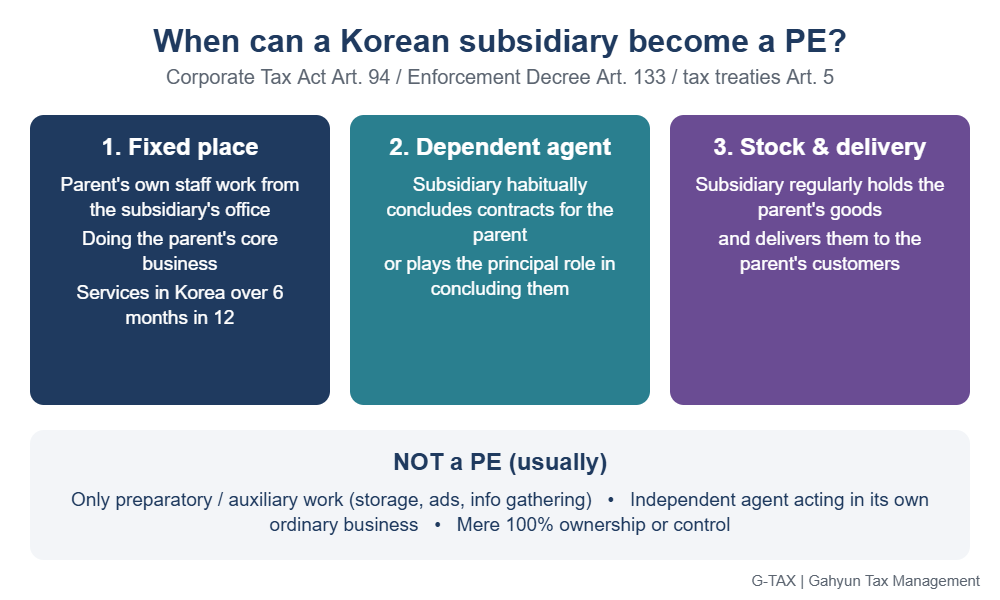
There is no rule that a subsidiary is automatically safe. Korean law and rulings show three main routes:
① The parent uses the subsidiary's office as its own fixed place. The Supreme Court requires that (a) the foreign company has the right to dispose of or use the place, and (b) it carries on essential and significant business activities there through its staff or people under its instructions (Supreme Court 2009Du19229). Long-term services by the parent's employees from the subsidiary's office (over 6 months in 12) are a typical risk. The NTS has ruled that supervising services provided through employees at a Korean site for more than 6 months create a PE (NTS 서이46017-10901, 2003.5.2.).
② The subsidiary acts as the parent's dependent agent. If the subsidiary habitually concludes contracts for the parent, or in substance decides the contracts the parent then simply signs, the subsidiary can be the parent's PE. The NTS confirmed that a Korean company that repeatedly exercises authority to conclude contracts for a foreign company is the foreign company's PE under Art. 94(3) (NTS 사전-2016-법령해석국조-0459, 2017).
③ The subsidiary holds the parent's goods and delivers them. Enforcement Decree Art. 133(1)1 includes a person who regularly keeps the foreign company's assets and habitually delivers them. The NTS ruled that a Korean warehouse operator keeping a Hong Kong company's goods and delivering them to Korean customers on its instructions was that company's PE (NTS 제도46017-10315, 2001.3.28.). The same 2017 ruling above says a Korean company that regularly keeps and delivers a foreign company's products is its PE.
When it is usually NOT a PE
- Only preparatory or auxiliary work in Korea (storage, advertising, information gathering). The NTS says such activity does not create a PE, but it is a question of fact.
- The subsidiary is an independent agent: legally and economically independent from the parent and acting in its own ordinary course of business. A 100% subsidiary under the parent's detailed control finds this harder to argue.
- Mere ownership or control: holding 100% of the shares does not by itself make the subsidiary a PE.
Practical example – watch out: The subsidiary imports equipment in its own name, but the parent pays the import VAT, the subsidiary pays nothing to the parent for the goods, and the subsidiary hands the equipment to the parent's Korean customers. In substance the subsidiary may be keeping and delivering the parent's goods, which is close to route ③. This structure should be reviewed (and ideally changed into a clear purchase-and-resale or a written logistics service agreement at arm's length).
4. Korean cases on subsidiaries and PE
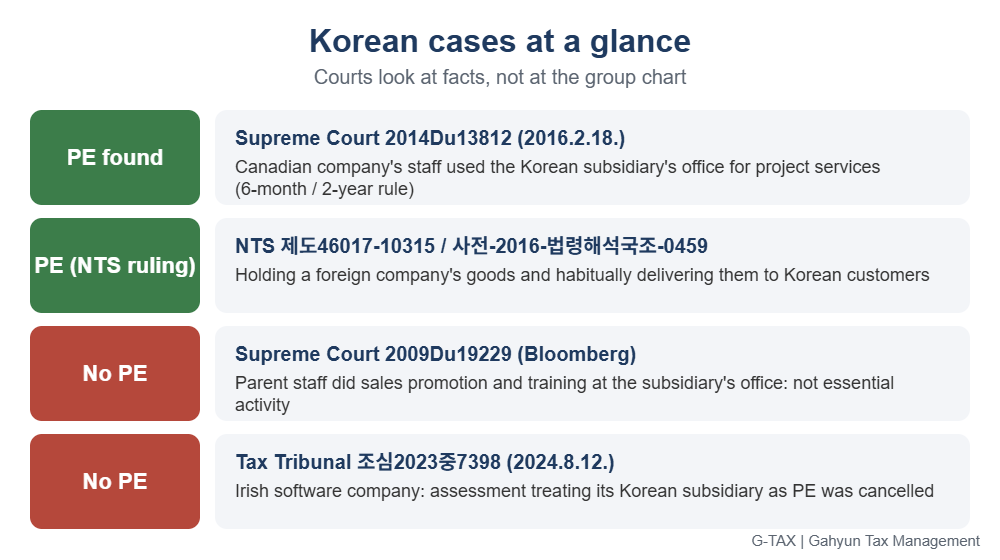
Case 1 – PE recognised: Supreme Court 2016.2.18. 2014Du13812
A Canadian company provided construction-related consulting and engineering services through its employees, working from the office space of its Korean subsidiary. The Court held that this office space was the Canadian company's PE, because the services lasted more than 6 months in 12 months, or similar services were provided continuously for over 2 years. The key point was not the subsidiary itself, but that the parent's own staff used the subsidiary's office to do the parent's business for a long time. In a related judgment on the same day (2014Du13829), the Court refused to split a contract into "Korean services" and "overseas services" where there was no reasonable business reason for the split.
Case 2 – PE denied: Supreme Court 2009Du19229 (Bloomberg)
A US company's Korean subsidiary delivered information services, and sales staff from the parent's overseas branches carried out promotion and training at the subsidiary's office. The tax office treated this as the parent's PE. The Court disagreed: the parent did not have the right to use the subsidiary's office as its own, and promotion and training were not essential and significant business activities.
Case 3 – PE denied: Tax Tribunal 2024.8.12. 조심2023중7398
The tax office treated an Irish software company as having a Korean PE, based on its staff activities and its Korean subsidiary. The Tax Tribunal cancelled the assessment, separating the parent's own business from the subsidiary's business.
Case 4 – NTS rulings on keeping and delivering goods
NTS 제도46017-10315 (2001) and NTS 사전-2016-법령해석국조-0459 (2017) show that a Korean company that regularly keeps a foreign company's goods and habitually delivers them, or repeatedly concludes contracts for it, is treated as that foreign company's PE. The Korean company being a group company does not change this.
Note: In our research we did not find a final Korean judgment that treats the subsidiary as such as the parent's PE. The risk comes from what the parent and the subsidiary actually do. Recent cases are moving through appeals, so the outcome of each case depends heavily on its facts.
Quick checklist
- Do the parent's employees work from the subsidiary's office for more than 6 months in 12?
- Does the subsidiary conclude, or effectively decide, contracts in the parent's name?
- Does the subsidiary keep the parent's goods and deliver them to the parent's customers?
- Is the subsidiary paid an arm's-length price or fee for what it does for the parent?
- Are roles and contracts between parent and subsidiary clearly documented?
If several answers are "yes", a PE review is recommended. G-TAX supports foreign-invested companies in Korea with this kind of review.
References: Corporate Tax Act Art. 94, 111; Enforcement Decree Art. 133; Supreme Court 2009Du19229, 2014Du13812, 2014Du13829; Tax Tribunal 조심2023중7398; NTS 서이46017-10901, 제도46017-10315, 사전-2016-법령해석국조-0459. Article numbers refer to the law as cited in those rulings; please check the current text at law.go.kr. This article is general information, not tax advice for a specific case.
G-tax(Korea) Tax firm specializing in foreign companies
If you are in search of a reliable English-speaking tax accountant, please don't hesitate to contact us! G-Tax Firm specializes in providing tax services exclusively for foreigners and foreign corporations in Korea. With extensive experience working with international companies, you can trust us for accurate and professional assistance


Thank you for read my article! I hope it helps.
If you want to see more information about Korea tax and accounting, please follow us.
And if you need help for your tax filing or accountung or looking for CPA in Korea, don't hesitate to contace us
G-tax / Certified Tax Accountant / Steven Yang
+82 10 9599 7152 / +82 32 832 6698
steven@g-tax.kr