
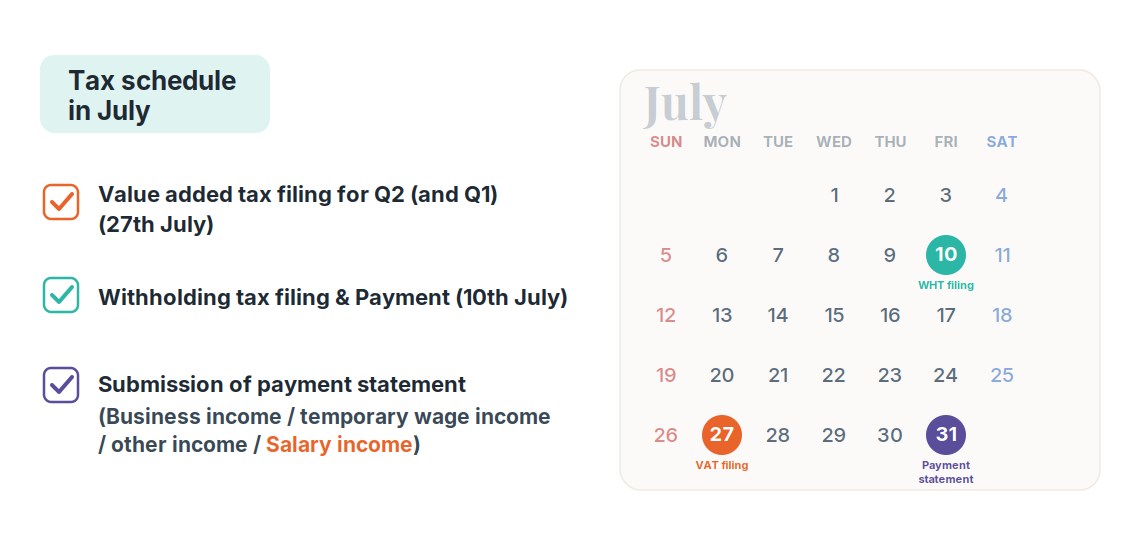

July is the month every business in Korea circles on the calendar — and VAT is the reason why. The VAT return is where a company's sales and purchases for the period get locked in and handed to the tax office. Once those numbers are filed, walking them back is painful. So of everything on this month's list, getting VAT right matters most.
Here's the catch that trips people up every July: this is the round where **every business(corporate and individual) files**.
Back in April, only corporations submitted their 1Q VAT and individual businesses sat it out. July is different — corporation or individual business, no one is exempt this time.
The one bit of relief: if you're a corporation that already filed 1Q (Jan–Mar), you're only on the hook for 2Q (Apr–Jun) now.

The rule of thumb is that a tax invoice goes out when you deliver goods or finish a service. But Korean tax law gives you breathing room: you can issue it as late as the following month.
Say you delivered on June 15th — you have until July 10th to issue the invoice, penalty-free. Slip past the 10th, though, and delayed-issuance penalties can kick in.

If a tax invoice that belonged in your 1Q filing slipped through the cracks, don't panic. You can fold it into this month's VAT return.

Two situations to watch. Individual business owners who skipped 1Q filing but already paid some VAT in Q1 can claim that back as a deduction now. And corporations that filed 1Q showing only a refund (nothing payable) can collect that refund through this month's return.

The moment you pay a salary, part of that money isn't yours to hand over — it's tax you're holding for the government.
A quick example. Your employee's contract says 2,000,000 KRW. You hold back 100,000 KRW in tax, pay them 1,900,000 KRW, and then you're responsible for reporting and remitting that 100,000 KRW to the tax office on their behalf.
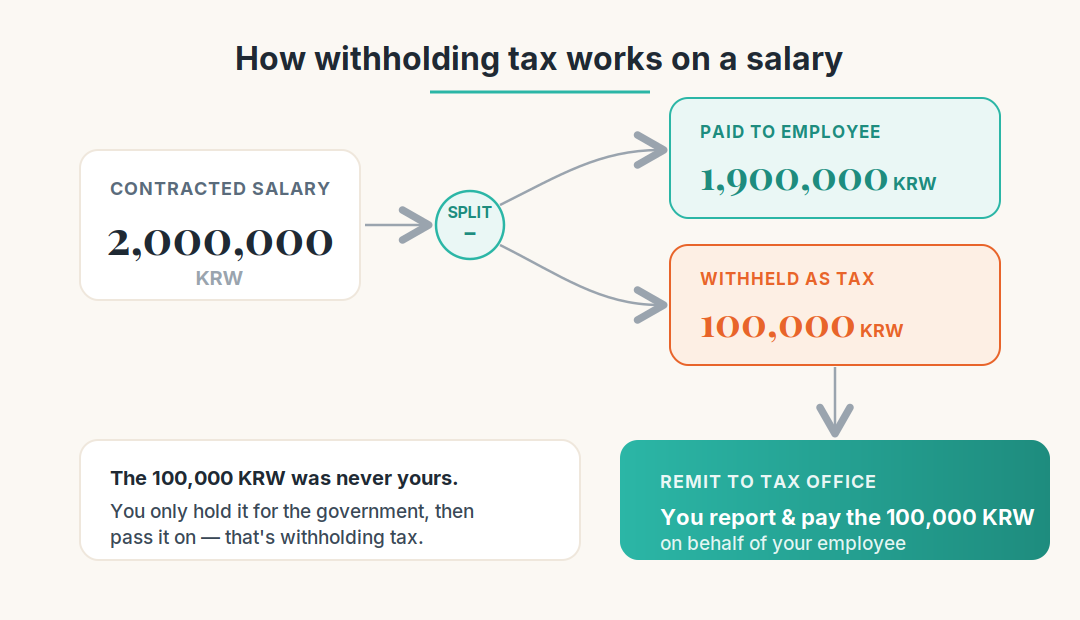
The clock works like this: file by the 10th of the month after you paid. Paid June salaries? Your withholding return is due July 10th.
And don't think of this as a payroll-only chore. **Any payment that carries a withholding obligation belongs on this return** — a royalty sent to a foreign company, for instance, gets withheld and reported the same way.

Think of a payment statement as the receipt for your withholding — a simple record of who you paid, how much, and how much tax you set aside along the way. Once you've withheld tax from someone and sent it to the tax office, this is the document that fills in the rest of the story for them.
How often you file just depends on the type of income:
- Business income · temporary worker income · other income → every month
- Salary income → twice a year, in July and January
The main thing is to get them in before the month wraps up. Filing late means penalty taxes, so it's best to treat July 31st as your finish line and give yourself a little room before then.
G-tax(Korea) Tax firm specializing in foreign companies
If you are in search of a reliable English-speaking tax accountant, please don't hesitate to contact us! G-Tax Firm specializes in providing tax services exclusively for foreigners and foreign corporations in Korea. With extensive experience working with international companies, you can trust us for accurate and professional assistance


Thank you for read my article! I hope it helps.
If you want to see more information about Korea tax and accounting, please follow us.
And if you need help for your tax filing or accountung or looking for CPA in Korea, don't hesitate to contace us
G-tax / Certified Tax Accountant / Steven Yang
+82 10 9599 7152 / +82 32 832 6698
steven@g-tax.kr

'Korea tax guide[Hometax]' 카테고리의 다른 글
| 9 Documents You'll Get When You Start a Business in Korea (0) | 2026.07.31 |
|---|---|
| The Corporate Tax Bill That Sneaks Up Every August — And How to Lower It (0) | 2026.07.29 |
| Your 2026 February Tax schedule (0) | 2026.02.04 |
| Your Year-end tax settlement guide 2026 [PDF download] (0) | 2026.01.23 |
| Your 2026 January Tax schedule (0) | 2026.01.02 |


