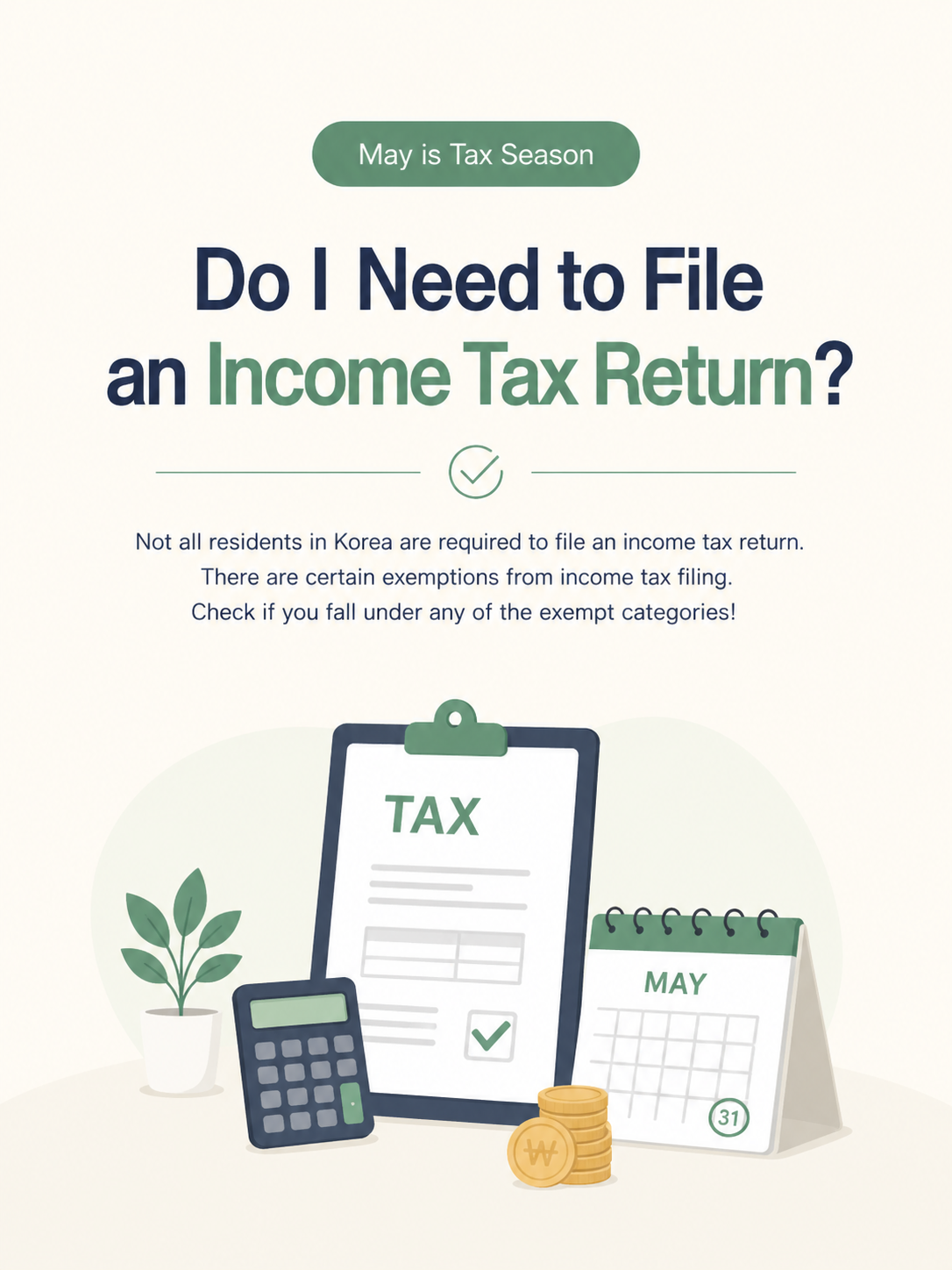
As we approach the month of May, it is important to note that this is the season for individuals to file their personal income taxes.
Under Korean tax law, any resident (regardless of nationality, meaning that even foreigners can be considered residents in Korea) who earned income during the previous year (from January 1 to December 31) is required to file an income tax return and pay any applicable taxes by the end of May.
However, not all residents are required to file an income tax return. There are certain exemptions from income tax filing. Therefore, if you fall under any of the categories below, you are not required to file an income tax return in Korea.
1.Exemption from filing income tax return in May

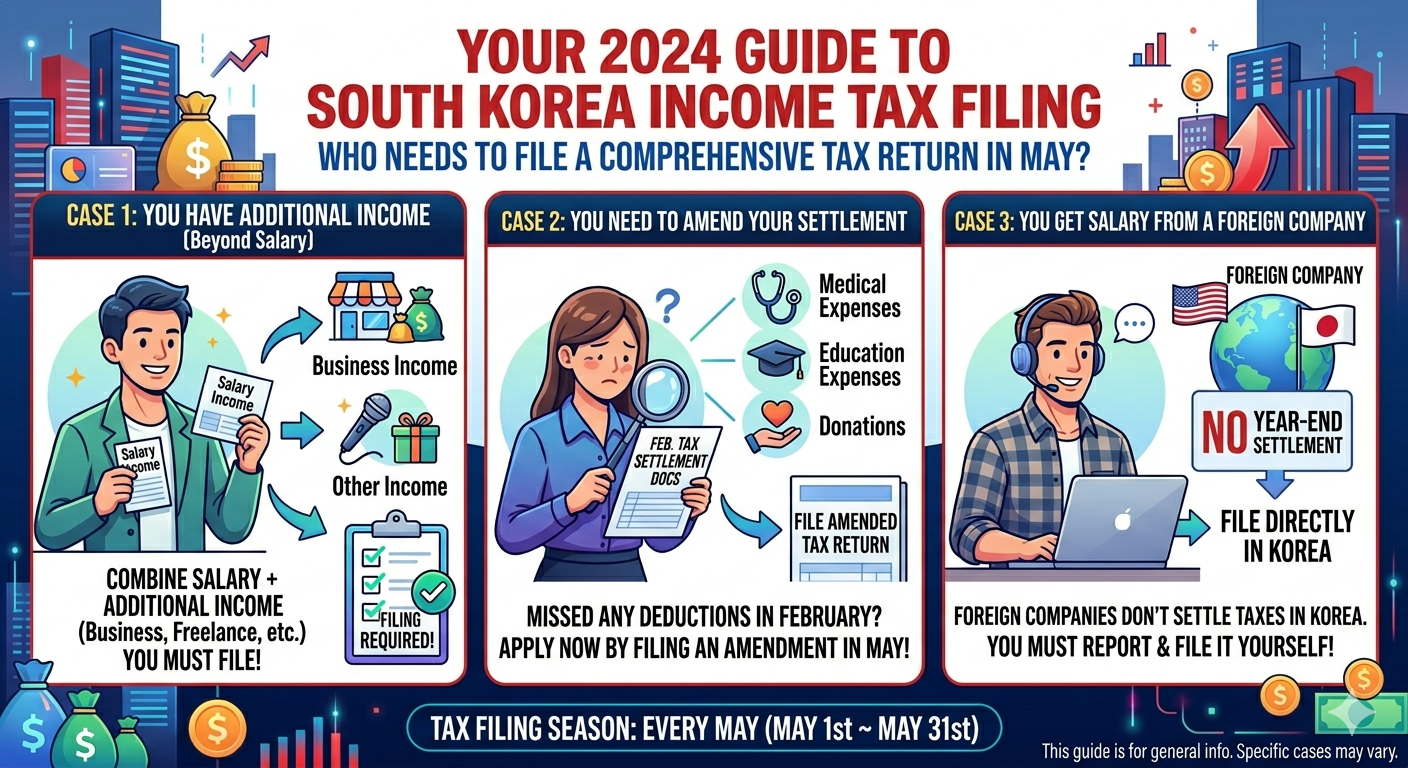
If you worked for a Korean company and received salary income from that company, and if this was your only income during the previous year, your income tax return has already been filed by your employer in February through the year-end tax settlement.
Therefore, you are not required to file a separate income tax return.
However, you must file an income tax return if you fall under any of the following cases:
1)If you have additional income other than salary, such as business income or other types of income
(This additional income will be combined with your salary income to calculate your total tax liability.) you need to prepare your income tax return.
2)If you wish to amend your year-end tax settlement,
(For example, if there are deductions you were eligible for but did not claim in February) you can apply for them by filing an income tax return.)
3)If your salary income is paid by a foreign company
(If you receive salary from a company located outside Korea) you are required to report this income and file an income tax return in Korea. cause foriegn company don't do the year-end tax settlement process that Korean company do.

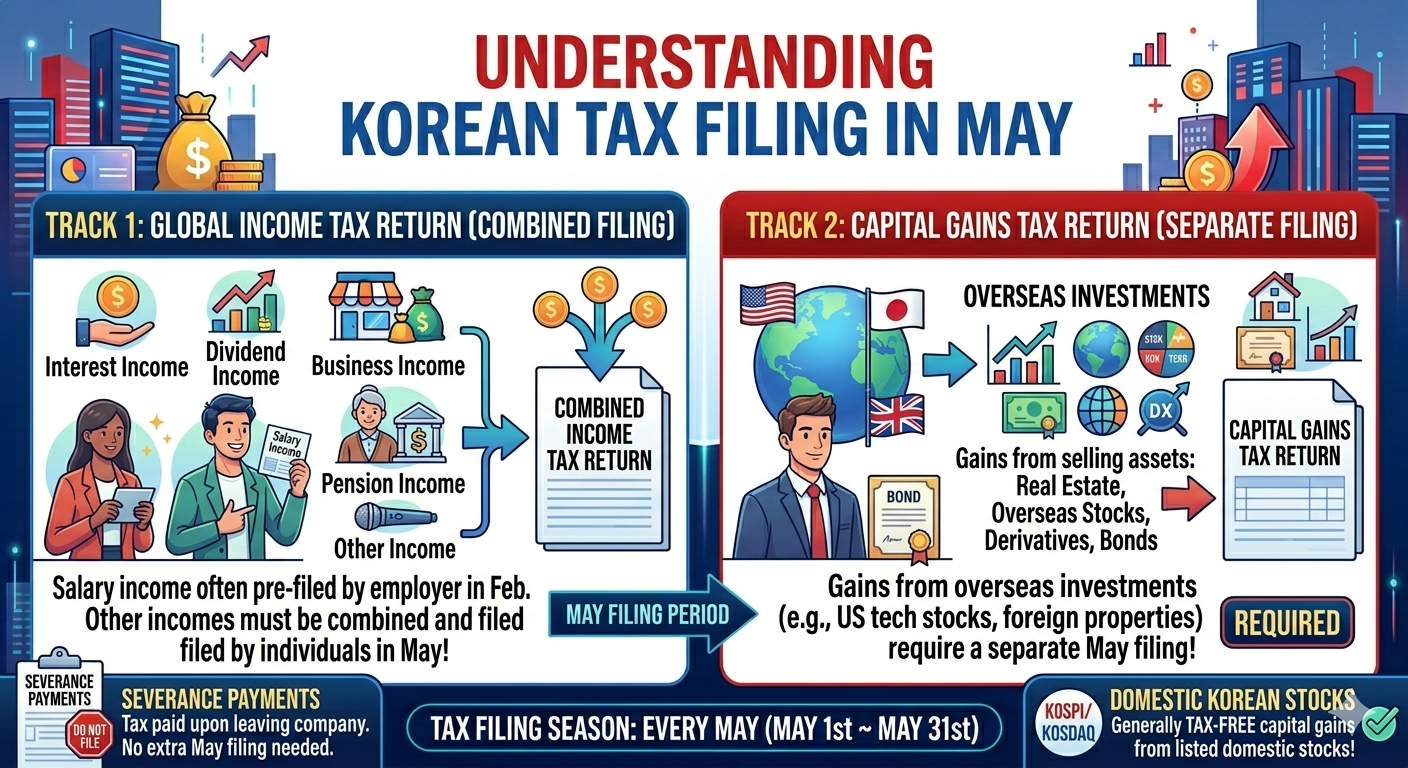
As you may know, capital gains from stocks listed on the Korean stock markets (KOSPI and KOSDAQ) are generally not subject to tax. However, if you earn capital gains from overseas investments, you may be required to pay tax on those gains.
This is referred to as capital gains tax, which must also be filed and paid in May. However, it is separate from the income tax return.
-Income tax return includes: interest income, dividend income, business income, salary income, pension income, and other income
-Capital gains tax return includes: gains from the sale of assets such as real estate, stocks, derivatives, and bonds
-Severance payments received upon leaving a company are not subject to additional tax filing
Therefore, if you have sold stocks, bonds, or other financial assets in overseas markets and earned a profit from those transactions, you are required to file a capital gains tax return, separate from your income tax return.

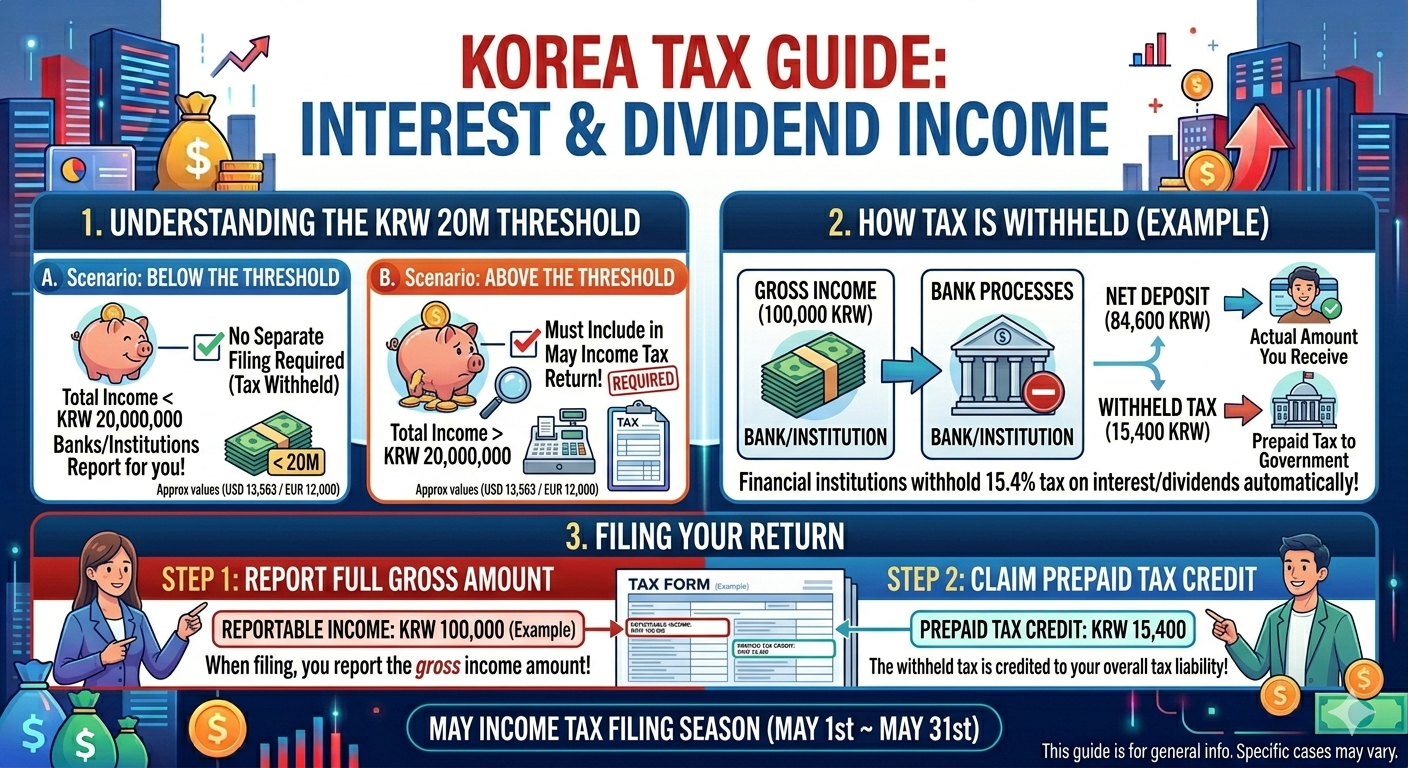
Interest and dividend income are usually reported by financial institution like bank when the total amount is below KRW 20,000,000 (approx. USD 13,563 / EUR 12,000). Therefore, even if you have such income, you are not required to include it in your income tax return if it does not exceed this threshold.
However, if your total interest and dividend income exceeds KRW 20,000,000, you are required to include it in your income tax return.
In most cases, taxes on interest and dividend income are already withheld by the financial institution like bank. For example, if you earn KRW 100,000 in interest, the actual amount deposited would be KRW 84,600, with KRW 15,400 withheld as tax.
When filing your income tax return, the full amount of income (KRW 100,000) will be reported, and the withheld tax (KRW 15,400) will be credited as a prepaid tax.
2.Real-Life Scenarios: Examples of Income Tax Filing in Korea
-------------------------------------------------Example 1--------------------------------------------------------
John worked for Samsung until 5/31/2025 and received a total salary of 50,000,000 KRW. He also received retirement income of 120,000,000 KRW at May/2025. Does John need to file his income tax return in May?
> No,
John does not need to file his income tax return in May. He only has wage and salary income, and retirement income is not included in income tax filing.
-------------------------------------------------Example 2--------------------------------------------------------
Philip has been working for Samsung and received a total salary of 120,000,000 KRW in 2025. He also earned income from giving lectures to other companies, totaling 40,000,000 KRW. Philip settled his year-end tax in February. Does Philip need to file his income tax return in May?
-> Yes
Philip needs to file his income tax return in May. Even though he settled his year-end taxes in February, he earned business income from another source, which requires him to file an income tax return in May.
-------------------------------------------------Example 3--------------------------------------------------------
Sarah has been living in Korea for more than 4 years and working for an overseas company, receiving a total salary of 150,000,000 KRW. Does Sarah need to file her income tax return in May?
-> Yes or No.
It depends on whether Sarah is a resident or a non-resident. If Sarah is a non-resident, she does not need to file her income tax return. However, if Sarah is a resident, she should report her income earned abroad to the Korea tax office. Please check the difference between residents and non-residents below.
3.Non-resident is also required to file income tax return.
*Resident means persons who has address in Korea or have lived in Korea more thatn 183days in a year , and non-resident mena persons who are not resident. (it's decided by the specific situation of each individual not just 183days)
Residents are required to report both their Korean income and any income earned abroad when filing their income tax return. On the other hand, non-residents are only required to report their income earned in Korea when filing their income tax return. Therefore, if you are a non-resident and have earned income in Korea, you must file your income tax return accordingly.
G-tax(Korea) Tax firm specializing in foreign companies
If you are in search of a reliable English-speaking tax accountant, please don't hesitate to contact us! G-Tax Firm specializes in providing tax services exclusively for foreigners and foreign corporations in Korea. With extensive experience working with international companies, you can trust us for accurate and professional assistance


Thank you for read my article! I hope it helps.
If you want to see more information about Korea tax and accounting, please follow us.
And if you need help for your tax filing or accountung or looking for CPA in Korea, don't hesitate to contace us
G-tax / Certified Tax Accountant / Steven Yang
steven@g-tax.kr