The Corporate Tax Bill That Sneaks Up Every August — And How to Lower It
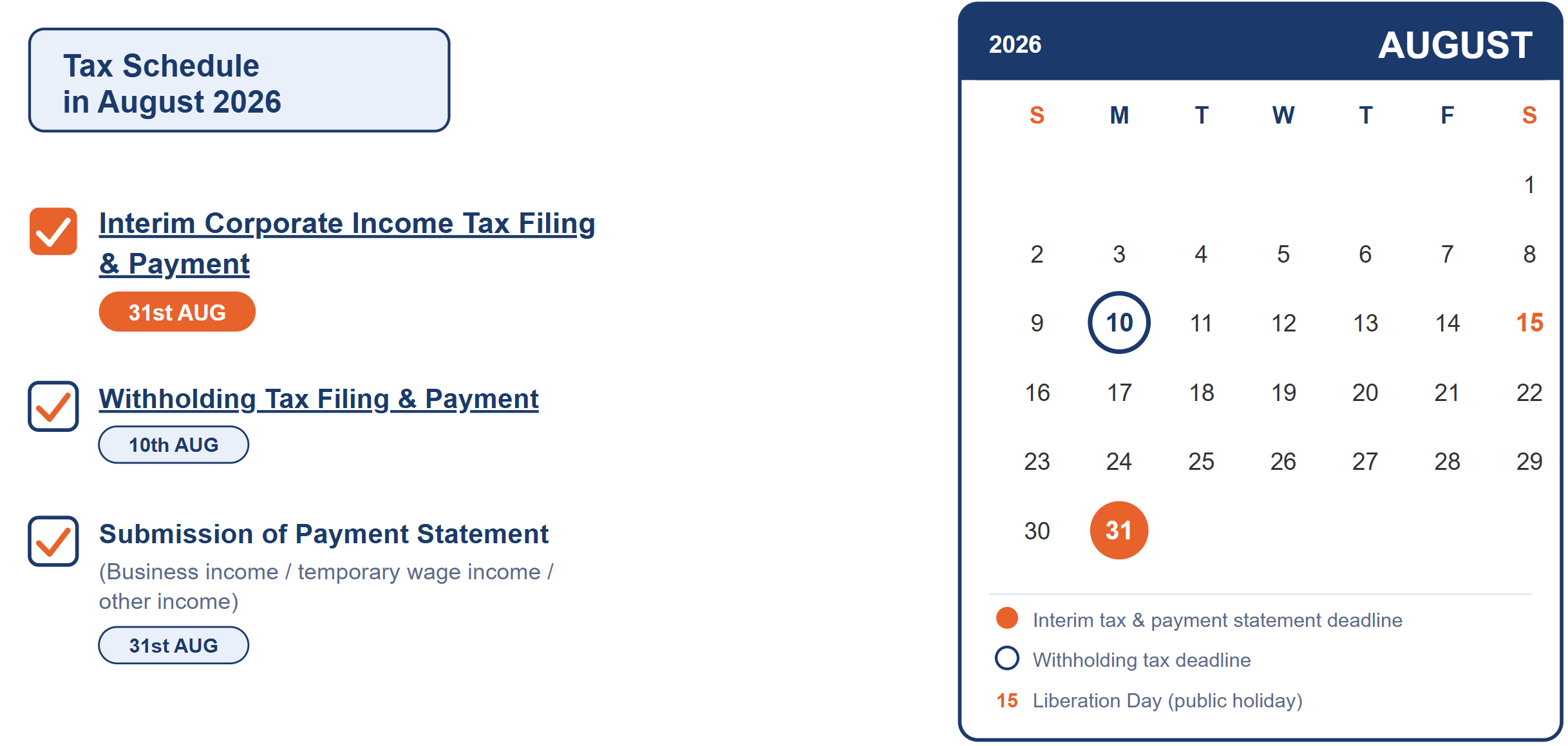
If your company runs on a calendar fiscal year — January through December, which most corporations in Korea do — August is not a quiet month. It's when interim corporate tax prepayment (법인세 중간예납) comes due.
Here's what it actually is, why it lands in August, who's off the hook, and how the amount gets calculated.

Corporations in Korea settle their corporate income tax once a year in March, based on a full fiscal year's revenue and expense.
But rather than waiting twelve months to collect any of it, the tax authorities require most companies to prepay a portion partway through the year. That mid-year advance payment is what "중간예납(Interim Corporate tax)" means — literally, paying in ahead of the final reckoning.
The logic behind it is straightforward. It keeps any one company from having to produce a full year's tax bill in a single lump sum, and it gives the government a steadier flow of revenue rather than one enormous wave of collections every March.
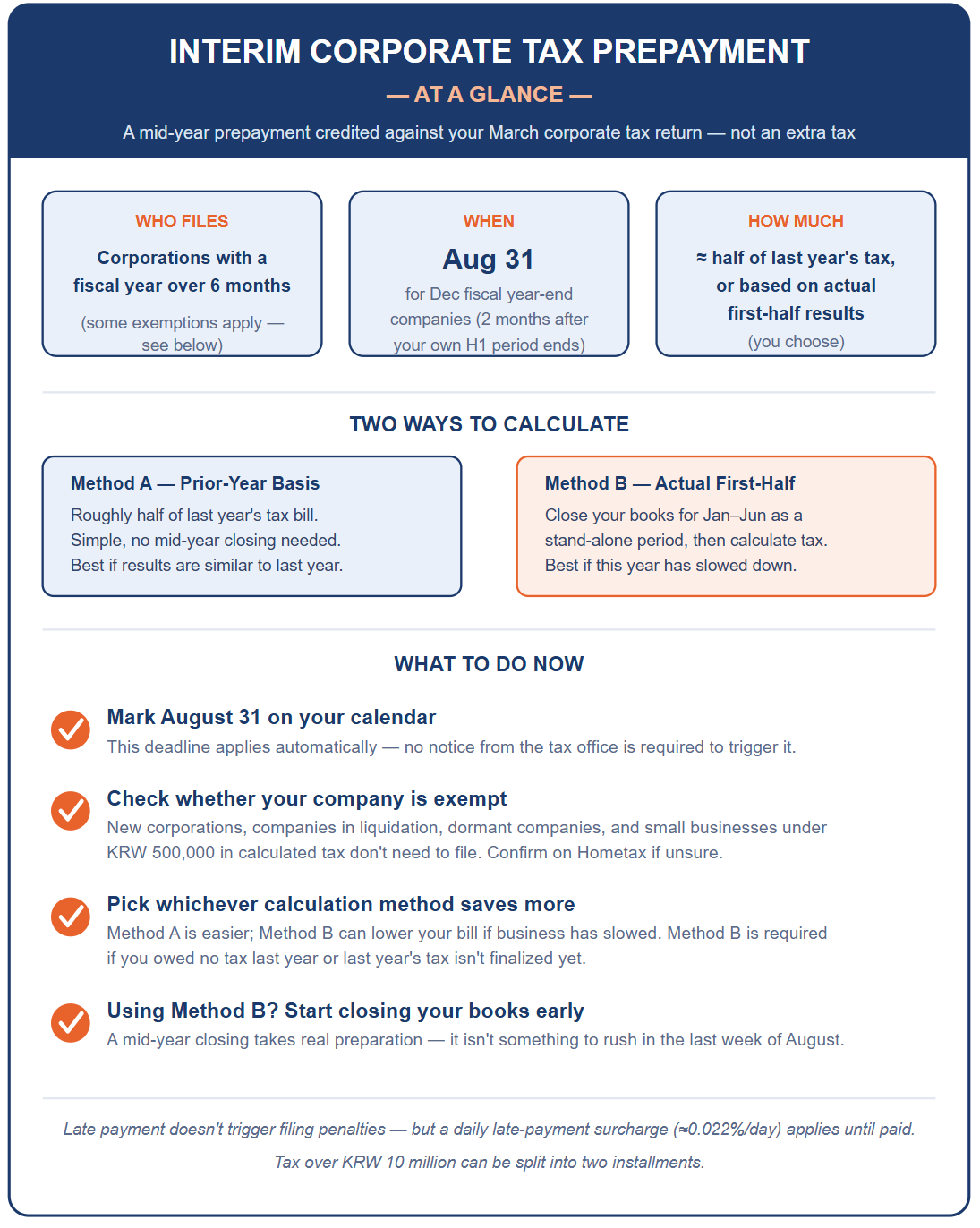
Most importantly for your own planning: what you pay in August isn't a separate, additional tax. It's a credit. The amount gets subtracted from your total corporate tax bill when you file your annual return the following March, so you're simply paying part of this year's tax early rather than owing anything extra.

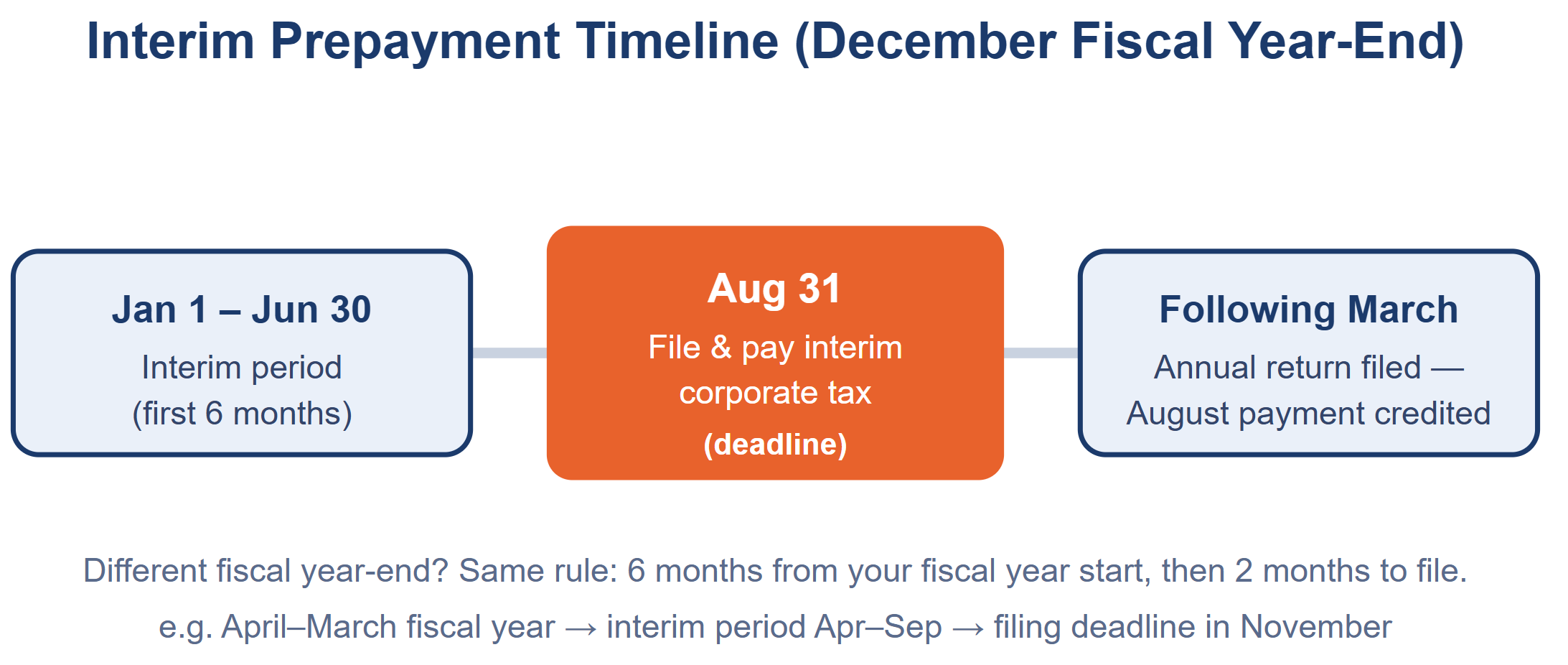
The interim prepayment period always covers the first six months of a corporation's fiscal year. For a company on the standard January–December fiscal year, that's January 1 through June 30. Korean tax law then gives corporations two months after that period ends to file and pay — which brings the deadline to August 31.
If your fiscal year runs on a different cycle, the same formula still applies: six months from your fiscal year's start, then two months to file. A company with an April–March fiscal year, for instance, would have its interim period run April through September, with the filing deadline falling in November.

Not every corporation has to file. The main exemptions are:
- 1)Newly established corporations in the fiscal year they were founded (this doesn't apply to companies created through a merger or division)
- 2)Corporations in liquidation
- 3)Corporations with no business revenue during the interim period for example, due to a suspension of operations
- 4)Small and medium-sized enterprises whose interim tax, calculated using last year's tax bill as the basis, comes out to less than KRW 500,000
If you're not sure whether your company qualifies, Hometax has a dedicated lookup (조회/발급 → 세금 신고납부 → 법인세 중간예납 세액조회) that will tell you directly whether you're exempt, rather than leaving you to work it out from the list above or you can ask to your tax accountant.

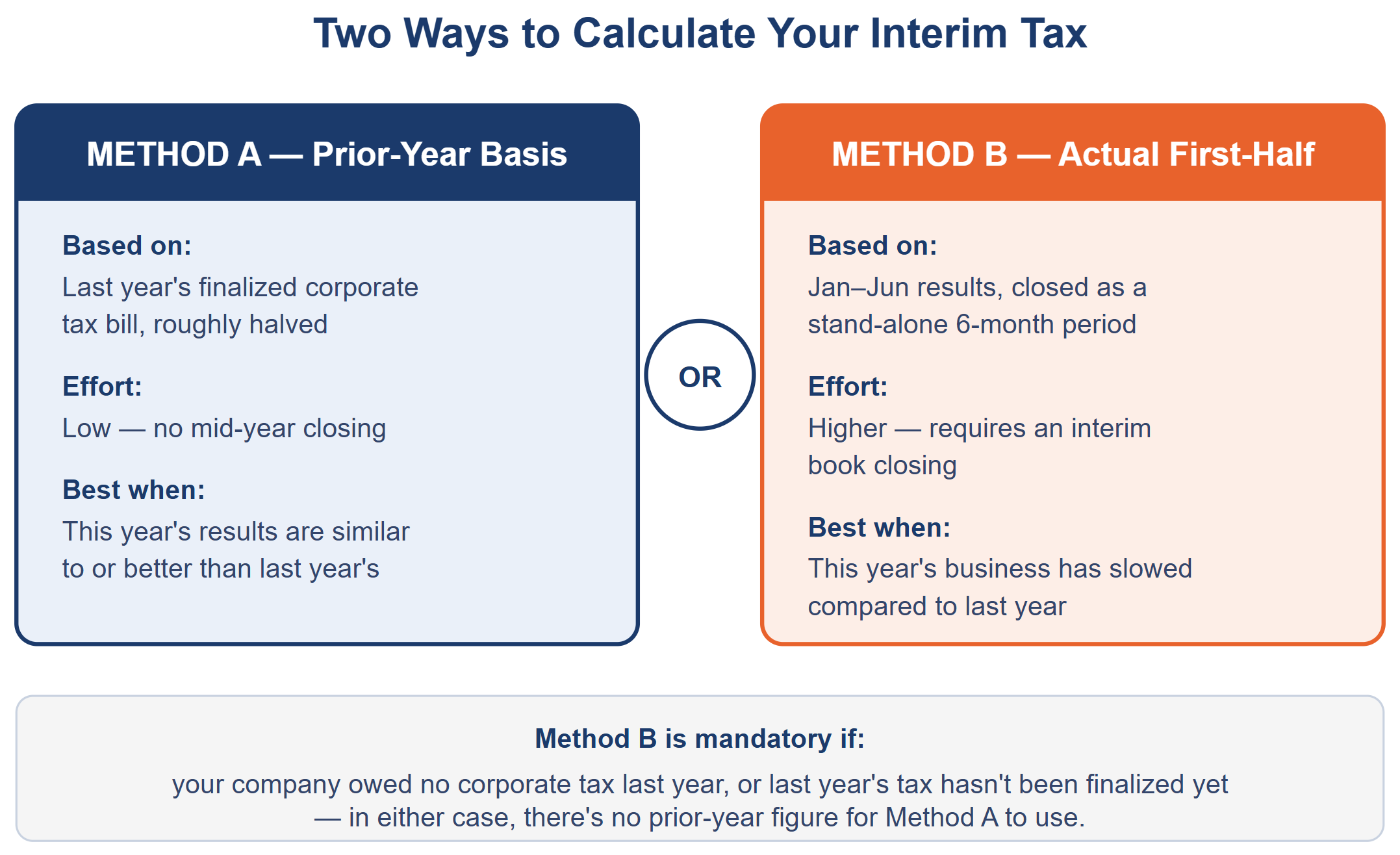
Once you know you need to file, there are two accepted ways to arrive at the amount.
Method A — Based on last year's tax bill.
This is the default and the simplest option for most companies. Take the corporate tax you were actually assessed last year, adjust it for certain credits, deductions, and any tax already withheld at the source, and the result is roughly cut in half to reflect a six-month period. No mid-year bookkeeping required — just a formula applied to a number you already have.
For example, last year's Corporate taxes are 10,000,000KRW -> 5,000,000KRW due by 31st Aug
Method B — Based on your actual first-half results.
Here, you close company's financial statement for January through June as though that period were a complete, stand-alone fiscal year, then calculate what your tax would be on those results. This takes more work since it means an interim closing, but it can lower your prepayment if business has slowed compared to last year.
For example, Make P&L statement for Jan~Jun. Let's say the revenue 100,000,000KRW and expense 50,000,000KRW -> Income 50,000,000KRW. Than apply corporate tax rates 10%, pay 5,000,000KRW or interim corporate tax
Companies are generally free to choose whichever method results in a lower payment. Method B becomes mandatory, though, if your company had no corporate tax liability last year, or if last year's corporate tax hasn't been finalized yet by the time this year's interim period wraps up — in either case, there's simply no "last year's bill" for Method A to work from.

Interim prepayment is technically a payment obligation rather than a filing obligation, which works in your favor if you're late: you won't be hit with the steeper failure-to-file or under-reporting penalties that apply to other tax returns.
What you will owe is a late-payment surcharge, calculated daily — roughly 0.022% of the unpaid amount for every day it goes unpaid, starting the day after the deadline.
If the amount you owe is large, you don't have to pay it all by August 31 either. Interim tax over KRW 10 million can be split into two payments — the first installment by the deadline, the remainder within one month after (two months for small and medium-sized companies).
G-tax(Korea) Tax firm specializing in foreign companies
If you are in search of a reliable English-speaking tax accountant, please don't hesitate to contact us! G-Tax Firm specializes in providing tax services exclusively for foreigners and foreign corporations in Korea. With extensive experience working with international companies, you can trust us for accurate and professional assistance


Thank you for read my article! I hope it helps.
If you want to see more information about Korea tax and accounting, please follow us.
And if you need help for your tax filing or accountung or looking for CPA in Korea, don't hesitate to contace us
G-tax / Certified Tax Accountant / Steven Yang
+82 10 9599 7152 / +82 32 832 6698
steven@g-tax.kr

